Support North Lawndale Community News with your Advertisement <img class=”alignleft wp-image-1668″ src=”http://www.nlcn.org/cms/wp-content/uploads/2017/06/The-North-Lawndale-Community-News-Ad-rate-card-web.jpg” alt=”” width=”504″ height=”717″ />
|
[huge_it_gallery id=”18″]
Independent contractor, Mr. Eric U. Strickland, invited NLCN to the headquarters of Wakanna, a company formed by four African American women, with the idea of capitalizing on the legalization in Illinois of the Hemp plant, Cannabis, and the health products derived from these two plants.
With the newly legalized industry in Illinois having only a tiny percentage of black ownership, Melissa Boston, CEO, Dr. Patricia Van Pelt, President, Phyllis Nash, CSO Chief Sales Officer, and Rita J. McGuire, MD CMO Chief Medical Officer, along with their business structure of direct selling, found a way to allow more African Americans to have a piece of the revenue derived from the industry. They have helped over 5,000 minorities join the Cannabis/CBD business space. Their business structure allows people to become their own merchants using their duplicatable system.
The company, Wakanna, launched on April 20, 2019 with the goal of becoming the largest and most reputable minority-owned Cannabis/CBD company in the world. Its headquarters is located at 411 E 35th St. in Chicago, IL. By 2025, they hope to operate as a full service Cannabis company.
An important aspect of Wakanna is their commitment to organic and vegan products of high quality. They use state of the art methods to remove THC, which is the psychoactive part of the Hemp and Marijuana plant. The recent signing of the 2018 Farm Bill made certain components of the Cannabis plant (CBD with less than .3% THC) legally available in all 50 states.
CBD is non psychotropic and therefore doesn’t cause a euphoric high. It is extracted from Hemp and Marijuana plants. It has numerous health benefits and contains nutritious substances such as chlorophyll, omega-3 fatty acids, terpenes, vitamins, amino acids and other phytocannabinoids.
Illinois legalized the sale of medical cannabis in 2015. Recreational cannabis became legal in Illinois on January 1, 2020. As of February 2021, two percent of Illinois dispensary owners were Black or Latino, 1 black and 2 Latino. At the end of 2021, the industry in Illinois is still in a legal and legislative battle to resolve the issues in equitable minority ownership.
Wakanna products come in the form gummies, edibles, water solubles, oils, creams, culinary infusion, and vapes. Their products are infused and some products contain other essential oils. Products from other companies may have pork or and in many cases are sprayed on. Wakanna products are full spectrum meaning compounds that have health benefits and are more effective for pain than CBD isolates because of the combined effects of CBD and other compounds in the plant. Whereas isolates are CBD only. The Wakanna website gives a breakdown of each of their products, their benefits, recommended doses and other important information.
Wakanna also manufacture their products at a 3rd party validated facility that has stringent compliance with the FDA and is a GMP certified facility that uses quality control steps to produce safe and effective products. With a range of reported health benefits, the uses for full-spectrum CBD include anti-seizure, muscle spasm relief, antianxiety, pain relief, treatment for psychotic disorders, antioxidant, and anti-inflammatory relief.
According to a World Health Organization (WHO) Trusted Source report, research has suggested that CBD oil may also have therapeutic benefits for the following conditions: Alzheimer’s disease, Parkinson’s disease, multiple sclerosis, Huntington’s disease, hypoxia-ischemia injury, pain, psychosis, nausea, inflammatory diseases, rheumatoid arthritis, infection, inflammatory bowel disease, cardiovascular disease, and diabetic complications.
On the day of visiting the headquarters of Wakanna, Mr. Otis McLaurin rode with us. McLaurin, is also a Wakanna Independent Contractor. He was enrolled into the business by Eric Strickland. Said McLaurin, “We got in on the ground floor. We’ve only been in it for two years. And now we’re approaching a 7 million-dollar company.”
When asked why he got into the business he responded, “Well, what made me get into it was the people that were in it, and knowing how they are, and one particular person was Eric (Strickland). I know Eric doesn’t do anything unless he checks it from the bottom, inside out and upside down. He’s a leader and I follow leaders and I got into it because of him and I know that he only gets involved in things that have the potential of becoming something and he can make it grow.”
Mr. McLaurin, in turn, also has recruited several people into his business. One that he mentioned was a psychiatric counselor who has also recruited five people into the business. “She has done a whole lot to stimulate my business, said McLaurin. He also uses Wakanna products like the gummies and CBD that he applies with liquid drops that he puts under his tongue.
Once we arrived, we met with Shannon King and Charles Porter. On the first floor of the building there are two entrances, one on the street side and the other connected to a shared parking lot. Their signature colors of black and gold resonated throughout the building. On the second floor is their meeting space and administrative offices. The space gives you a modern feel of progress and future growth. The walls are painted with the names of members and televised screens of the people, products and vision of Wakanna for life.
Ms. Shannon King was working in a section where scheduled independent contractors can sell products to walk-in or by appointment customers. There are more than the 84 listed products on their website. Products can also be purchased at the Wakanna headquarters.
How much does it take to start a business in Wakanna? There are three different ways of participating in Wakanna for life franchises. You can purchase a Crown Jewel dispensary which is their best value. The Millennial Dispensary or the Stimulus Dispensary. They even have a no money down 30-day Test Drive Dispensary where they hope you make enough commission to start your business with product on them. Their goal is to eliminate any barriers so that the average person can win.
For more information, please go to the Wakanna website at strickcomcbd.wakannaforlife.com or contact Eric U. Strickland at strickcom@gmail.com. Office 872-204-6010
[huge_it_gallery id=”21″]
Getting up early in the morning at 5:00 am to meet at Cong Danny K. Davis westside office at 2700 West Madison to get on an Aries Charter Bus proved to be very satisfying. Arriving there at 6:18am the bus had not arrived yet but the Congressman’s office was open. Several families going to visit incarcerated family members were parked in cars. Crystal and Willie Burton from the Davis’ office were there to greet those going on the trip.
Photographer and videographer Keith McDonald had an interesting conversational about
 SSGKobe, rapping at Summer Smash 2021 on Saturday before it rained. SSG stands for Super Saiyan God,” taken from the Dragon Ball Z animation. Even amid Covid-19 and other negative factors, the third Summer Smash in Douglass Park seems to still have been a charm for more in the future.
The special effects of sound, lighting, pyrotechnics, and CO2 helped make Summer Smash 2021 more exciting, where it was used. It was a three-day event starting on Friday thru Sunday. The 1st day, Friday included headliner A$AP Rocky, also Latto, Lil Yachty, Swae Lee, Teezo Touchdown, Baha Bank$, Supa Bwe, and more even though it began a little disorganized.
The 2nd day, Saturday, experienced a 2-hour strong rain delay after Joey Purp and SSG Kobe performed. There was also conflict from some festival attendees stealing from and attacking the bartenders. Headliner, Lil Baby along with City Girls, Gunna, City Morgue, and many more. The day was full of excitement and downtime, but provided satisfactory energy at the end.
Day 3 of the event headlined by Lil Uzi Vert had surprise guests such as Chance the Rapper, Wocka Flocka Flame, Benny the Butcher, Bktherula, Lil Durk and many more performed. There was also a Juice WRLD tribute on that Sunday. The 3rd day ended better which convinced festival the organizers of Lyrical Lemonade Summer Smash to come back next year and do it better. The planning and logistics of a concert event is not an easy undertaking. Even though making a profit and an intense desire for the music genre is inherent there are a lot of other moving parts involved. Safety, security, timing, and good organization are always a challenge. Even mother nature and human nature can inflict disaster. All these were present this year but were overcome in the end.
 Black Contractors protesting at the central headquarters of CHA because of the dismantling of JOC program that provided business and job opportunities. 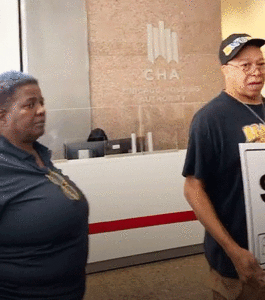 Ms Patricia Davis (left) protesting unfair dismantling of CHA’s JOC Program which benefited small Black Contractors. Black contractors, who were part of the Chicago Housing Authority (CHA)’s JOC (Job Order Contracting) Program, have not been able to work since November of 2020 because of the dismantling of the program by the CHA. Small black contractors and their employees came together to protest the loss last Wednesday, June 23rd at the CHA Central headquarters because of the drastic economic loss of livelihood and the impact of that loss. According to Patricia Davis, President of Unique Casework Installations, Inc., a contractor and also a certified union carpenter for over 20 years, they were under a contract that does not expire until September 2021. Another protest is planned on Thursday June 30 at city hall.
The Federal Government began using JOC in the mid-1980’s as a delivery method for small to medium sized construction work. The purpose of Section 3 is to make HUD-financed employment and economic opportunities available to low-income residents, which includes CHA and low-income Chicago area residents. In June of 2018 NLCN ran a story on several small contractors who benefited from the program, Hood Construction Company owned by Dennis Hood a CHA resident and Community Section 3 Consulting, owned by Paul Mckinley, who successfully advocated for and participated in jobs and contracts for CHA residents. Unfortunately, Mr. Hood passed away in February of 2020.
The goal of the JOC program is to foster a partnering atmosphere between increasing Section 3 Business Concerns participation and provide them the opportunity to perform progressively complex and higher valued projects. Contractors are expected to consistently perform at a high level of performance quality on all assigned projects,
HUD recently changed its definition of a Section 3 Business. CHA will be transitioning to this new definition which is 51% owned by a CHA resident(s) or HCV participant(s), 51% owned by a low-income person (s), and A business where low-income persons make up 75% of the labor hours
The protesters were among the 115 companies in the Job Order Contracting (JOC) program and their fingers are being pointed at CHA, the mayor’s office and the administration appointed by the mayor. Stated Ms. Patricia Davis in an email to them, “the CHA is already aware of our issues which are the reinstatement of the JOC Program and the JOC Contractors. We also want to know why the JOC Program was dismantled in the first place; Try and make this, make sense to us, taking away the livelihood of Small Black Contractors and putting it in the hands of Wealthy Owned Companies,” Those wealthy companies are a who’s who list of development companies.
The CHA and larger companies took away the opportunity for the smaller companies to be their own general contractors. Now they have to wait on the development companies, and the general contractors have to wait on CHA to get paid. Creating and extra layer of delay to get paid and according Ms. Davis the process is taking away smaller jobs from the small black contractors. Which is why they are protesting, that they have been cutoff and are being put out of work, because the larger companies are eating up the opportunities and the small profit margins?
Davis and other JOC contractors that benefited from the program also stated the Administration was more favorable when Rahm Emmanuel was the mayor, Ben Carson was the HUD secretary, Eugene Jones was the Chief Executive Officer, and John T. Hooker was the CHA Board Chairman. Currently, Lori Lightfoot is the mayor, Marsha L Fudge is the HUD secretary, Tracey Scott is the Chief Executive Officer, and John T. Hooker was the CHA Board Chairman, and Angela Hurlock is the Board Chairperson. NLCN will be following this story to report on past HUD benefits and future outcomes with CHA compliance, HUD and JOC contractors that were part of the program.
By Todd Thomas
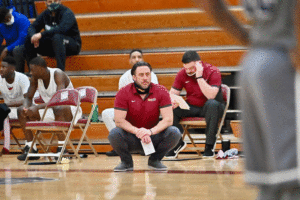 
Back in March of 2020 when the coronavirus pandemic shut down sports at many schools Triton College decided to stay the course and let the student athletes play. The start of the season was delayed, and schedules had to be modified, but the school put protocols in place and commenced with the basketball season. Trojans’ Head Coach Steve Christiansen answered a few questions about the 2021 season with NLCN.
NLCN: Did you ever think you would not have a season?
Coach C: When the pandemic first started in the spring of 2020 we were concerned, but our school was committed to having a season from the beginning. We had confidence all along that this was going to happen.
NLCN: Once you got started how did it go. Did the COVID-19 protocols interfere?
Coach C: We wore masks at certain spots in the building, but not the players during games. We traveled with masks, but in hindsight it wasn’t that big of a deal to me, and we didn’t have one incident with coronavirus, and we were very fortunate in that regard. If your respectful of it (coronavirus) and treat it with the proper precautions, you can deal with it. I thought it was a little premature when some schools cancelled their seasons.
NLCN: Did the lack of fans in attendance have any effect?
Coach C: We always like to have the energy of the fans, but we’re not the type of team that sells out the building so that really didn’t affect us.
NLCN: You finished 20-4. How would you rate the season overall?
Coach C: We did alright, we had a nice group of kids, and they were about the right things. They played hard and I really enjoyed coaching this team. But in the playoffs we ran into a really good team in the Midwest District Championship game, and we just didn’t have enough left in the tank at the end of the season. It was different because of COVID and all, but it worked out. You’re always disappointed if you don’t win the ultimate prize, but we had a good year and I’m proud of them. They were good kids to coach and that was really enjoyable to me. I’m proud of them for that, and for me it was almost a therapeutic experience with mostly good stuff
NLCN: Have any of your players signed with four-year schools yet?
Coach C: Kejuan Clements is going to Eastern Illinois and Lewis Rowe is going to Virginia Military Institute. Because of coronavirus recruiting has slowed down a lot. Normally guys would have things lined up by now – we just have to be patient.
By Todd Thomas
[huge_it_gallery id=”11″]
North Lawndale College Prep was on top of the Chicago-area basketball world between 2006-2009, winning a state and city championship in the process. The Phoenix weren’t stacked with star athletes, relying instead on a team of role players and unyielding defense.
Point guard Zilijin Jones was the team captain and leader on the court for most of the run, and while the five-foot nine floor general didn’t put up eye-popping statistics, he was valued for his toughness, basketball IQ, and leadership skills. This package of skill and effort would earn him a college basketball scholarship, and eventually a successful career playing professionally around the world.
Jones has played in the Dominican Republic, Morocco, Spain, El Salvador and China on his basketball journey. He said traveling the world gives him a unique perspective on certain aspects of life in the United States.
“The United States is very isolated and closed-minded. People think America is the land of the free, but here is where you usually end up putting yourself in debt. People work a billion hours on a job to obtain a big house with a white picket fence and a nice car. But what I learned is that you can get the same things in other countries for a lot cheaper without going into so much debt,” Jones said.
But it’s not just his financial awareness that grew while living abroad. He also bolstered his intellectual and cultural knowledge while traveling and living in different countries.
“The biggest plus to playing overseas is being exposed to other cultures,” Jones said. “I speak Moroccan, French and Spanish now – all because I was overseas. I was always focused on going overseas, and I never had any dreams of playing in the NBA. I knew what I wanted to do, and I always wanted to go overseas to play.”
However, playing basketball overseas is not all about experiencing other cultures. It’s about performing on the court and doing your job for your ball club that matters most.
“You have to be professional. A lot of Americans show up overseas and lose sight of why they’re there. You can’t just go clubbing every weekend. You have to remember that they signed you up to come over there to play basketball not to come experience their country. And if you’re not performing, they will send you home,” Jones said.
North Lawndale College Prep has built a solid reputation as a school that prepares it’s student for life after high school, and Jones said that his involvement in extracurricular activities there helped him succeed. “Outside of basketball at NLCP I was sent to a lot of Phoenix Rising programs that had me interact with different ethnicities and studying different religions and cultures. Every summer I went to programs out of state and that gave me a broader and better outlook on life, and I was ready to adapt to college,” he said.
Jones credits former NLCP head coach Lewis Thorpe, as well as mentor Lauren Foster, for helping him develop his skill and mentality on the basketball court.
“I owe my work ethic to coach Thorpe, and my toughness to Lauren Foster who already had me tough since I was in eighth grade. She and coach Thorpe helped me develop the mental aspect of the game and holding others accountable on the court. These are the things that have helped me succeed in basketball. I owe Lauren Foster everything,” he added.
Jones currently lives in Florida as he awaits the return to normalcy on the basketball circuit once the COVID-19 pandemic finally subsides. He isn’t interested in being overseas with the pandemic still raging, and many basketball leagues in other countries are playing without foreigners now.
Jones grew up on the west side of Chicago, not far from the NLCP Christiana campus, and recalls a lot of crime and gun violence that still plagues the community today. It’s been several years since he called Chicago home, and he said he doesn’t miss the trouble he’s seen on the streets of North Lawndale.
Another Phoenix standout basketball player, Jonathan Mills, was gunned down in 2016 in front of a store on Roosevelt Road in North Lawndale, and that tragic murder still weighs heavily on Jones, who was Mills’ cousin and whom he considered a brother.
“Right now, my brother (Mills) being killed is something I’m still not over. I try to stay away from Chicago because there’s nothing but bad memories for me. I’m in an area in Florida now where my car door is unlocked, and my keys are in the dash. I don’t have to worry and that’s what life is about – none of this craziness. It’s much more relaxing and pleasant here and overseas without living with your head on a swivel because you don’t know what’s coming next, Jones said.
Next for Jones will most likely be another stint playing overseas. His options are Spain, Russia or France, with France being his first option. And why not – he’s already played in Spain, so why not continue exploring the world playing the game he loves.
|
|
|